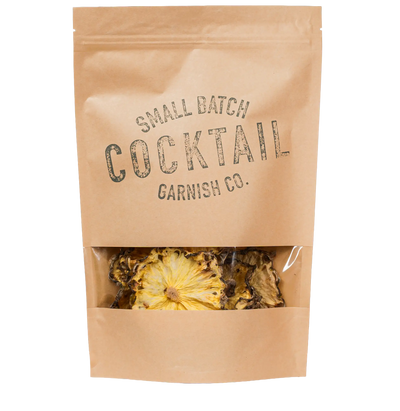
We dry pineapple every week in White Plains, New York, alongside the citrus that built this company. It's the most technically demanding fruit we run and the most rewarding one to get right — a properly dried pineapple wheel is a translucent gold sunburst with a naturally scalloped edge. Nothing else in the garnish drawer looks like it.
Here's the part most guides won't tell you up front: pineapple is not citrus, and nearly every failed batch comes from treating it like citrus. Pineapple's sugar content is what makes dried pineapple taste like candy. It's also what makes it brown early, weld itself to your trays, and go soft in the jar three weeks later.
This guide is the process we use, published without reservation. All three methods — food dehydrator, oven, and air fryer — plus the pineapple flower technique, the yield math, the conditioning step that prevents storage mold, and a cocktail pairing guide. If you'd rather skip the fifteen hours, we sell the finished version: dehydrated pineapple slices, 15 large wheels to a bag.
Why Dehydrated Pineapple Earns Its Place Behind the Bar
Fresh pineapple is the most expensive garnish decision a bar makes. A whole fruit costs several dollars, takes ten minutes to break down, yields a fraction of its weight in usable garnish, and starts weeping juice within an hour of being cut. By the end of service a tray of fresh pineapple wedges is a sticky, browning liability, and whatever you didn't use is gone tomorrow.
A dehydrated pineapple wheel removes every one of those problems. It's shelf-stable, it costs the same on a Tuesday as it does on a 400-cover Saturday, and it doesn't leak. It perches on a rim, spears cleanly on a pick, and floats on the foam of an espresso martini without sinking.
It's also the highest-impact garnish per dollar in tropical drinks. A Piña Colada with a dried pineapple wheel reads as a cocktail program. The same drink with a bare straw reads as a pour. That gap is the entire argument for dried garnish, and it's widest on tiki and tropical builds where presentation is the product.
[QUOTE]Pineapple is the garnish that makes a drink look like a vacation. It's also the one home batches ruin most often — not from lack of care, but because everyone dries it like an orange. It isn't an orange. It's sugar with a fruit wrapped around it.[/QUOTE]
Building a full tropical lineup? Browse our seasonal and tropical garnish collection.
What You'll Need
Ingredients
- 1 fresh whole pineapple — ripe, heavy, fragrant at the base; see the variety guide below
- Cool water for washing
- That's it. No sugar syrup, no sulfur, no acid dip, no blanching. Extension food-preservation programs recommend pretreatment for light-fleshed fruits that brown enzymatically — apples, pears, peaches — not for a fruit that's already deep gold and sitting at pH 3.2–4.0. We explain why in the browning section.
Equipment
- Sharp chef's knife — for the crown, base, peel and eyes. This part is knife work, not mandoline work.
- Mandoline slicer — for the wheels themselves. A pineapple is a wide, wet cylinder, and freehanding a uniform ⅛" cross-section through it is close to impossible. Uneven slices are the number-one cause of half-scorched batches.
- Cut-resistant glove — genuinely non-negotiable here. Pineapple is slick with sugar and juice and it fights the blade more than citrus does.
- Food dehydrator (preferred), or a conventional oven, or an air fryer with a dehydrate function
- Mesh tray liners or non-stick drying sheets — mandatory for pineapple. This fruit's sugar bonds to bare mesh in a way lime never does.
- Wire cooling rack + rimmed sheet pan (for the oven method)
- Standard 12-cup muffin tin — only if you're making pineapple flowers
- Clean kitchen towels or paper towels for blotting — you'll use more than you expect
- Airtight glass mason jars or vacuum-sealed bags for storage
- Food-safe silica gel desiccant packs — important for citrus, mandatory for pineapple. Dried pineapple is hygroscopic; it pulls moisture straight out of the air.
- Optional: a kitchen scale, if you want to use the commercial weight test
Choosing the Right Pineapple — Variety & Ripeness
Before the variety table, the single most important fact about buying pineapple, and the one almost no drying guide mentions.
Pineapple is non-climacteric. It does not ripen after harvest. Unlike a banana or an avocado, a pineapple's sugar content is fixed the moment it's cut from the plant. UC Davis Postharvest guidance sets a minimum of 12% soluble solids at harvest for acceptable flavor and notes that the fruit must be picked ready to eat, because it will not improve off the plant. Leaving a green pineapple on your counter for a week does not sweeten it — it softens it, which is senescence, not ripening. A soft, under-sweet pineapple dries into a pale, sour, flabby wheel.
What to look for at the store: golden-yellow color creeping up from the base, heavy for its size, firm shoulders with a little give, crisp green crown leaves, and — the single best test — a sweet, unmistakably tropical smell at the stem end. No smell means it was picked green. A vinegary or fermented smell means it's past it.
| Variety | Dried Result | Flavor Profile | Best For | Approx. Wheel Diameter |
|---|---|---|---|---|
|
MD-2 / "Gold" / Extra Sweet (the standard US supermarket pineapple) |
Deep translucent gold; best color retention, most consistent | Very sweet, low acid, high aroma — typically at the top of the 11–18% soluble-solids range | The workhorse — Piña Coladas, Mai Tais, rum punch, tiki service | 3.5"–4.5" (large; halve for coupes) |
|
Smooth Cayenne (the classic canning variety) |
Paler yellow, slightly more fibrous, dries a touch faster | Sharper and more acidic — good when you want the garnish to cut cream of coconut | Painkillers, colada builds, anything heavy and sweet | 3.5"–4.5" |
|
Queen / Victoria (small tropical varieties) |
Bright gold, tight eye pattern, best petal definition | Intensely sweet, crisp flesh, low acid | The best flower variety, and coupe or Nick & Nora rims where a full wheel is too big | 2"–3" — fits a rim without cutting |
| Sugarloaf / White | Very pale, delicate, tears easily | Extremely sweet, very low acid, soft flesh | Snacking — not a structural garnish | 3"–4" |
|
Canned rings (packed in juice, drained) |
Uniform, pre-cored, pale, noticeably softer | Flat and one-note next to fresh — canning heat already drove off the aromatics | Practice runs and snacks; not a premium garnish | ~3", fixed by the can |
Pro note from our production floor: use a Gold/MD-2 unless you specifically want small-diameter wheels, in which case hunt down Queen or Victoria fruit. And buy one grade riper than you think you need. Pineapple loses perceived sweetness in the dehydrator because the acid concentrates right alongside the sugar — a fruit that tasted merely fine fresh will taste tart dried.
One thing to avoid: pineapple with soft brown patches at the base or a fermented aroma. Overripe fruit has already begun breaking down structurally, and those slices come out of the dehydrator limp and translucent-brown instead of gold.
Prep: Crown, Peel, Eyes, Core & Slicing
Pineapple prep takes three to four times longer than citrus prep. There's no way around it, and rushing it is where most batches are lost. Budget the time.
[RECIPE] Prep: Breaking Down & Slicing a Pineapple Prep time: 15–25 minutes per fruit Yields: 30–45 garnish-quality wheels per medium pineapple at ⅛" Ingredients: - 1 ripe pineapple (Gold / MD-2 recommended) - Cool water for washing Equipment: - Sharp chef's knife - Paring knife for the eyes - Mandoline slicer set to ⅛" (3mm) - Cut-resistant glove - Clean kitchen towels or paper towels Steps:
- Wash the whole fruit under cool running water before you cut it. The exterior of a pineapple is field-soiled, and anything on that rind rides your knife straight into the flesh.
- Cut off the crown and the base — about ½" from each end, so the fruit stands flat and stable on the board.
- Stand it upright and cut the peel away in strips, top to bottom, following the curve of the fruit. Take off as little flesh as you can; you'll come back for the eyes.
- Remove the eyes. This is the step that separates a professional-looking wheel from a homemade one. The eyes are woody, they never dry into anything pleasant, and they read as dark brown flecks in the finished slice. Either dig each one out with a paring knife or — faster and prettier — cut shallow diagonal V-channels that follow the natural spiral of the eyes around the fruit. Those channels are what give a dried pineapple wheel its scalloped, flower-like edge.
- Decide on the core. Leave it in for garnish wheels: it holds the slice together structurally and gives you the classic bullseye. Cut it out with a round cutter only if you're drying for snacking, where the fibrous texture is unpleasant. A cored wheel is significantly more fragile and tears more easily on the mandoline.
- Slice on a mandoline set to ⅛" (3mm) for crisp garnish wheels. Our production wheels run right around 2.75mm. Work steadily with a glove on — pineapple is slippery and grabs the blade differently than citrus does.
- Blot hard, both sides, twice. This is not optional and it is not the same effort as blotting a lime. Pineapple is roughly 86% water and it sheds free juice continuously. Lay the wheels in a single layer, press firmly with towels, then lift them onto fresh dry towels and press again. Surface juice is what welds slices to trays and what turns edges brown before the center is dry.
[/RECIPE]
[PROTIP]Work over a bowl and save every drop of juice you press out — a single pineapple gives up a surprising amount, and it's the best fresh mixer you'll have all week. Do not, however, dip your slices back into it. Adding sugar-heavy liquid back to the surface is the fastest route to a batch that never stops being sticky.[/PROTIP]
Leathery or Crisp? Pick Your Target First
This is the fork in the road no other guide flags, and it explains why published drying times for pineapple range from six hours to eighteen. There are two completely different finished products, and they are not the same recipe.
| Leathery / Chewy (Snack) | Crisp / Rigid (Bar Garnish) | |
|---|---|---|
| Slice thickness | ¼" (6mm) or chunks | ⅛" (3mm) — the commercial standard |
| Dehydrator time at 135°F | 8–12 hours | 10–16 hours |
| Finished feel | Pliable; bends without breaking; pleasantly chewy | Snaps cleanly; holds a rim; holds a pick |
| Residual moisture | Higher — shorter shelf life, conditioning essential | Lower — the stable one for long storage |
| Works as a garnish? | No. It droops off a rim and slides down a pick. | Yes. This is what we make. |
If you're here for cocktails, you want the crisp column — thinner slices and a longer dry than most pineapple recipes online will tell you, because most of them are written for trail snacks.
Method 1: Food Dehydrator — The Professional Method
[PHOTO] A finished commercial-grade wheel: translucent gold, scalloped edge from cleanly cut eyes, rigid enough to hold a pick horizontally.[/PHOTO]
For pineapple, a dehydrator isn't just preferable — it's close to necessary if you want crisp garnish wheels instead of caramelized chips. Controlled low heat plus continuous airflow is the only combination that pulls water out of a sugar-saturated slice before that sugar starts browning.
The target temperature is 135°F (57°C), which sits inside the 135–140°F finishing range Penn State Extension recommends for drying fruit. The same source names the exact failure you're avoiding: dry too hot and the outer surface hardens before interior moisture can escape — case hardening. In pineapple that looks like a wheel that seems finished, snaps at the edge, and reveals a wet, glassy center when you tear it. That batch molds in the jar.
Expect pineapple to take longer than any citrus you've dried. Plan on 10–16 hours for ⅛" wheels, where our lime wheels finish in 8–12 and our orange slices in 6–9. Thick full-diameter rings from a large fruit can run past 18.
[RECIPE] Method 1: Food Dehydrator Temperature: 135°F (57°C) Time: 10–16 hours for crisp ⅛" garnish wheels; 8–12 hours for chewy ¼" slices Batch size: Limited only by your tray count
- Preheat the dehydrator to 135°F and let it reach full temperature before loading anything.
- Line every tray with a mesh liner or non-stick drying sheet. Skip this and you will lose slices — pineapple sugar bonds to bare mesh harder than any fruit we run.
- Arrange the blotted wheels in a single layer with at least ½" between them. Pineapple wheels are wide and shed moisture fast in the first two hours; they need more clearance than citrus, not less.
- Load the trays and start the timer.
- At the 2-hour mark, peel every wheel off the liner and reseat it. Early. This is the single most useful instruction in this guide. Two hours in, the surface sugars have concentrated but not yet set — break the bond now and the slices release cleanly for the rest of the run. Wait until hour six and you'll be tearing them.
- At the 4-hour mark, rotate trays top-to-bottom and front-to-back to even out airflow variation inside the unit.
- Flip every wheel at hour 6, and again at hour 10.
- Start checking for doneness at hour 10. Do not test a warm slice. Pull one, let it cool a full 5 minutes on the counter, then run the snap test. Warm pineapple feels soft and tacky even when it's finished, and that mistake costs people entire extra cycles.
- Pull trays as they pass. Outer-edge slices finish first — that's airflow, not a defect. Wheels with the core still in will be the very last to finish.
[/RECIPE]
[PROTIP]Verify your dehydrator's actual temperature with an oven thermometer laid on a tray. Consumer units routinely run 10–15°F off their dial, and with a fruit this sugary that margin is the difference between translucent gold and dark caramel. If you check one appliance in your kitchen, check this one.[/PROTIP]
[product]pineapple[/product]
Method 2: Oven — How to Dehydrate Pineapple Without a Dehydrator
No dehydrator? An oven works, and it's faster — roughly 4 to 7 hours instead of 10 to 16. The tradeoff is more severe with pineapple than with citrus. At 170°F you're well above the ideal drying window for a high-sugar fruit, so expect noticeably deeper amber color, some caramelized edges, and a chewier finished texture. That can be delicious. It's just not the same product.
170°F (77°C) is the target, and there's a practical reason for it: it's the lowest setting most American home ovens offer. If yours bottoms out at 200°F, use 200°F with the door propped and expect a candied result closer to a pineapple chip.
[RECIPE] Method 2: Oven Drying Temperature: 170°F (77°C), or your oven's lowest setting. Use convection if you have it — it cuts roughly 25% off the time. Time: 4–7 hours conventional, 3–5 hours convection Batch size: 1–2 sheet pans per session
- Preheat to 170°F (77°C) and put an oven thermometer on the rack. Home ovens commonly run 25–40°F off the dial, and with a fruit this sugary that error is the whole ballgame.
- Line sheet pans with parchment, then set a wire cooling rack on top. The rack lifts the wheels so air circulates underneath — a pineapple slice laid flat on a pan sits in its own released juice and candies rather than dries.
- Arrange the blotted wheels in a single layer on the rack. No overlapping.
- Prop the oven door open 1–2 inches with a wooden spoon handle or a folded kitchen towel. Pineapple releases far more water vapor than citrus, and a sealed oven simply recirculates it. Skip this only if you're using convection.
- Flip every 45 minutes, and blot the rack with a paper towel each time for the first two hours. Pooled juice under a slice scorches into a dark ring.
- Start checking at the 4-hour mark, cooling a slice for 5 minutes before testing.
- Pull individual wheels as they pass rather than waiting for the whole pan. Oven batches finish unevenly by nature.
[/RECIPE]
[PROTIP]Above roughly 220°F actual temperature, pineapple sugar caramelizes faster than water can leave the slice. You'll get a dark, brittle, faintly burnt-toffee wheel — which some people love as a snack and nobody wants on a Piña Colada. If your oven can't hold below 200°F, dry in passes: 45 minutes on, 20 minutes off with the door open, repeat. The rest periods let interior moisture migrate outward without cooking the surface.[/PROTIP]
Method 3: Air Fryer — Read This Before You Start
Air fryer results for pineapple vary more than for any other fruit, and the reason is the same one that confuses people with limes: two completely different appliances share one name. Here's the distinction that resolves it.
If your air fryer has a "Dehydrate" function
Most oven-style air fryers (Ninja Foodi, Instant Vortex Plus, Cosori dual-function models) will hold 120–135°F (49–57°C). That's the real drying range and it produces genuinely good pineapple. Expect 4–7 hours for ⅛" wheels, flipping at least twice. Capacity is the limitation, not quality.
If your air fryer is a basket model with a 150°F floor
Standard basket units won't go below 150–180°F. With citrus that gives you a darker wheel. With pineapple you are essentially making candy: the sugars caramelize, the edges go deep brown and chewy-crisp, and the result is closer to a pineapple chip than a garnish. Use the lowest setting your unit allows and work in short passes: 15 minutes, flip, 15 minutes, then check every 10. Total time is usually 45–90 minutes. Genuinely tasty. Not a bar-quality wheel.
[RECIPE] Method 3: Air Fryer Temperature: 120–135°F if your unit has a dehydrate function; otherwise the lowest available setting (typically 150–180°F) Time: 4–7 hours on dehydrate; 45–90 minutes on a basket model Batch size: 4–8 wheels per round, single layer only
- Preheat to your target temperature.
- Lay the wheels in a single layer on the rack or in the basket with clear space around each one. Halve large wheels if they won't lie flat — a folded slice dries into a folded slice.
- Dehydrate function: run 90 minutes, release and flip every wheel, then continue in 45-minute intervals until the snap test passes.
- Basket model: run 15 minutes, flip, run another 15, then check every 10 minutes. These go from perfect to burnt inside a single interval.
- Cool a test wheel for 5 minutes before judging it. Trust the snap test, not the timer — air fryer variance between machines is enormous.
[/RECIPE]
[PROTIP]A basket air fryer's fan will pick up a thin pineapple wheel and throw it into the heating element. Weigh the slices down with a small metal rack or an air-fryer-safe trivet for the first pass, until they stiffen enough to stay put.[/PROTIP]
Bonus Method: How to Make Dried Pineapple Flowers
[PHOTO] A pineapple flower floated on espresso martini crema — the highest-impact garnish you can make at home, and it costs you one extra step.[/PHOTO]
The pineapple flower is the reason to learn this fruit. It's a wheel dried in two stages — flat until pliable, then shaped in a muffin tin until rigid — so the petals curl upward into a cupped bloom. It looks like it came from a hotel bar in Bangkok, and it's genuinely easy.
Two rules determine whether you get a flower or a taco. First, the eyes must be removed with clean spiral V-channels — those notches are the petal separations, and without them you get a smooth-edged bowl. Second, the shaping has to happen while the slice is still pliable. Wait until it's crisp and it cracks down the middle when you press it in.
[RECIPE] Bonus Method: Dried Pineapple Flowers Temperature: 135°F (57°C) dehydrator, or 200–225°F (93–107°C) oven Time: 4–6 hours flat plus 3–6 hours shaped (dehydrator); about 1 hour flat plus 1–2 hours shaped (oven) Yields: 12 flowers per muffin tin Equipment: - Standard 12-cup muffin tin, ungreased - Mandoline slicer set to ⅛" (3mm) - Paring knife for the eye channels Steps:
- Prep the pineapple as above, taking extra care with the spiral V-channels around the eyes. Deep, clean notches make defined petals.
- Slice at ⅛" (3mm). Thicker slices won't cup; thinner ones tear when you shape them.
- Blot obsessively. Flowers hold their shape only if the slice stiffens evenly, and surface juice ruins that.
- Stage one, dry flat. Dehydrator: 135°F for 4–6 hours. Oven: 200–225°F on a rack for about 30 minutes per side. You want a slice that has lost its floppiness and feels like soft leather — bendable, not brittle, no longer wet to the touch.
- Stage two, shape. Press each warm, pliable slice down into a cup of an ungreased muffin tin. Push the center in and let the edges ride up the sides, then fingertip-shape the petals so they separate.
- Stage two, set. Return the tin to the heat. Dehydrator: 135°F for 3–6 hours. Oven: 200°F for 1–2 hours. Done when the flower holds its shape completely unsupported and snaps at the petal tip.
- Cool in the tin for at least 20 minutes. Removing a warm flower is how you lose the shape you just spent nine hours building.
[/RECIPE]
[PROTIP]No muffin tin? Crumpled aluminum foil pressed into cone shapes works, and so do small ramekins. What matters is that something holds the petals up while the last of the moisture leaves. Once fully set, flowers nest like paper cups for storage — layer them with parchment and add a desiccant pack to the jar.[/PROTIP]

Method Comparison at a Glance
| Method | Temp | Time (⅛" wheels) | Batch Size | Result | Best For |
|---|---|---|---|---|---|
| Food Dehydrator | 135°F (57°C) | 10–16 hrs | Large (multi-tray) | Best — translucent gold, crisp, consistent | Bar programs, bulk batches, flowers, top quality |
| Oven | 170°F (77°C), door propped | 4–7 hrs | Medium (1–2 sheet pans) | Good — deeper amber, chewier, some caramelized edges | Home use, no dehydrator, same-day results |
| Air Fryer (dehydrate function) | 120–135°F (49–57°C) | 4–7 hrs | Small (4–8 wheels) | Very good — near dehydrator quality | Small, high-quality batches |
| Air Fryer (basket, 150°F floor) | Lowest setting available | 45–90 min | Small (4–8 wheels) | Candied — dark, chewy-crisp, closer to a chip | Tonight's drinks, or a very good snack |
How to Know When They're Done
Pineapple is harder to call than citrus, because sugar makes a finished slice feel tacky. Tackiness is not wetness, and confusing the two is why people either over-dry pineapple into brittle shards or pull it wet and lose the batch to mold. Here are the three tests we run, in the order we run them.
The Snap Test
Pull a wheel and cool it at room temperature for a full 5 minutes — longer than you'd cool a lime, because sugar-rich fruit stays pliable while warm. Then bend it firmly. A correctly dried garnish wheel snaps cleanly: stiff, with a distinct break. If it folds into a U without breaking, it needs more time. If you're targeting the chewy snack texture instead, you want exactly the opposite — leathery, bends without cracking, no wet spot at the core.
The Press Test
Tear a cooled wheel in half and press the cut edge hard between your fingers. There should be zero moisture transfer. The surface may feel faintly sticky — that's concentrated sugar and it's normal and permanent. What isn't normal is dampness, a cool sensation, or flesh that dents and holds the dent. The flesh right around the core is the last part to finish and the part that will fool you.
The Weight Check (Commercial Method)
At production scale we weigh batches before and after. Fresh pineapple is roughly 86% water, so a finished batch has lost 82–88% of its starting weight. One pound of fresh prepped slices should come out around 2–2.5 oz dry. If your finished weight is meaningfully higher, there's still water in the batch, and it will find you later in the jar.
[QUOTE]With pineapple we run the press test on the ring right around the core, not the outer flesh. The rim of a pineapple wheel finishes hours before the middle does. If the core ring passes, the batch passes.[/QUOTE]
Why Does Dried Pineapple Turn Brown?
Dried pineapple turns brown because of sugar and heat, not oxidation. As water leaves the slice, the fruit's natural sugars concentrate dramatically — published drying research has measured fresh pineapple going in at around 12°Brix and coming out of the dryer in the 76–89°Brix range. At that concentration, heat drives caramelization and Maillard browning readily, and the higher the temperature and the longer the exposure, the darker the result.
This is why an acid dip does very little here. Citric and ascorbic acid pretreatments target enzymatic browning — the reaction that turns cut apples, pears and peaches brown, which is exactly how Colorado State University's fruit-drying guidance frames the recommendation. Pineapple is already acidic (pH roughly 3.2–4.0, with titratable acidity of 0.5–1.6% per UC Davis) and already deep gold. The lever that actually controls browning is temperature.
What actually reduces browning
- Run 135°F, not higher. Every 10°F above that visibly darkens a sugar-heavy fruit. This matters more for pineapple than for any citrus.
- Blot until the towels come away dry. Surface juice is concentrated sugar sitting on the hot side of the slice. It browns first and it browns hardest.
- Slice thinner. A 3mm wheel spends far less total time under heat than a 6mm one, and browning tracks total heat exposure.
- Wipe pooled juice off racks and liners for the first two hours. A slice sitting in its own runoff scorches into a dark ring underneath.
- Store in the dark. Light continues to dull dried pineapple in the jar even after a perfect dry.
What to expect, honestly
A correctly dried pineapple wheel is translucent amber-gold — deeper at the outer flesh, pale at the core, with a slightly darker scalloped edge. It's noticeably darker than fresh pineapple and it should be; that color is the concentrated sugar you're after. What signals a real problem is opaque dark brown, hard shiny edges, or a burnt-caramel smell. That's a temperature failure. Drop 10–15°F and add hours.
Why Dried Pineapple Stays Sticky (and What to Do About It)
Every other guide either ignores this or blames under-drying. Both are wrong. A properly dried pineapple wheel is slightly tacky to the touch, permanently, and that is not a defect. You've concentrated a fruit from roughly 12°Brix to somewhere north of 75°Brix. That surface is essentially candy.
The problem isn't the tackiness itself — it's what the sugar does afterward. Concentrated fruit sugar is hygroscopic: it actively pulls water vapor out of the surrounding air. Left in a jar without protection, dried pineapple re-softens faster than any citrus we make. That's why the storage section below matters more here than anywhere else.
How to tell tacky from wet:
- Tacky (fine): the surface has slight grab, but the slice is rigid, snaps when bent, and leaves no moisture on your fingers.
- Wet (not done): the slice feels cool, dents under pressure, bends without breaking, and transfers dampness when you press a torn edge.
If the stickiness genuinely bothers you for handling or packing, a light dusting of cornstarch is the standard commercial workaround for candied fruit. We don't do it — our bags are 100% pineapple and nothing else — but it's a legitimate option at home.
Yield: How Many Wheels You Actually Get Per Pineapple
Pineapple has the worst yield of anything in our lineup, and it isn't close. Between the crown, the peel, the eyes and the trim, you lose roughly half the fruit's weight before a single slice hits a tray. Here are our numbers, with discards already subtracted.
| Input | Slice Thickness | Garnish-Quality Wheels | Approx. Dried Yield |
|---|---|---|---|
| 1 medium pineapple (3–4 lb whole) | ⅛" (3mm) | 30–45 full wheels | ~3.5–5 oz |
| 1 medium pineapple (3–4 lb whole) | ¼" (6mm) | 15–22 wheels | ~3.5–5 oz |
| 1 lb prepped, peeled flesh | ⅛" (3mm) | 20–28 wheels | 2–2.5 oz |
| 1 small Queen / Victoria pineapple | ⅛" (3mm) | 15–25 small wheels (2–3", rim-ready uncut) | ~1.5–2.5 oz |
| 1 medium pineapple, made into flowers | ⅛" (3mm) | 24–36 flowers (two muffin-tin loads) | ~3.5–5 oz |
Why "garnish-quality" is doing work in that column: a whole pineapple physically produces more slices than that. But the top and bottom cuts are discards, the first and last wheels are undersized and lopsided, any slice that hits a missed eye carries a brown blemish, and in any real batch a few tear on the mandoline or bond to a liner. Plan on 30–45 usable full wheels per medium fruit and you'll be close.
Practical math for a bar program: a 150-drink tiki weekend needs four to five pineapples' worth of dried wheels — call it 90 minutes of break-down and slicing, four to five dehydrator trays, and a full overnight cycle, before anyone has flipped, cooled, conditioned or packed anything. Pineapple is where the in-house-versus-buy math flips hardest of any garnish we make. For reference, a bag of our dehydrated pineapple slices holds 15 large wheels at 2.5"–3.25" diameter, and wholesale pricing is here.
Conditioning & Storage
Everything in this section matters more for pineapple than for citrus, because sugar attracts water. A perfect batch stored casually will be soft in a month.
Step 1: Cool completely — 30 minutes minimum
Let every wheel cool at room temperature for at least 30 minutes before it touches a sealed container — longer than the 20 minutes we give citrus, because dense sugar-rich slices hold heat. Residual heat becomes steam inside a closed jar, steam becomes condensation, and condensation rehydrates the batch from the inside.
Step 2: Condition for 7–10 days
Conditioning equalizes residual moisture between slices and — critically — reveals under-drying before it becomes mold. Almost nobody publishes this step. It's the difference between a batch that keeps and a batch you throw out.
- Pack the cooled wheels loosely into a clean glass jar, filling it about two-thirds full. Seal it.
- Store at room temperature, out of direct light, for 7–10 days.
- Shake the jar once a day. This redistributes moisture and — with pineapple specifically — keeps the tacky surfaces from fusing into a single block.
- Check the glass daily for condensation. Any moisture on the inside of the jar means the batch is not dry. Return the whole batch to the dehydrator for another 2–3 hours, cool, and restart the conditioning clock.
- Ten days with no condensation means the batch is stable and ready for long-term storage.
Step 3: Store it properly
- Airtight glass mason jars — ideal. Glass doesn't off-gas or interact with fruit acids.
- Vacuum-sealed bags — excellent for volume, and the best defense against re-softening.
- Resealable kraft pouches with oxygen absorbers — how we ship to wholesale bar accounts.
- One food-safe silica gel desiccant pack per jar — treat this as mandatory, not optional. Citrus tolerates going without. Pineapple does not.
- Layer flowers with parchment so the petals don't fuse. Nest them; don't stack them flat.
- Cool, dark, dry. A pantry shelf or back-bar cabinet. Not a windowsill, not above the stove, not next to the fryer.
- Don't refrigerate. Every door opening runs a condensation cycle, and a sugar-rich slice absorbs that moisture immediately.
Shelf life
- Cocktail and culinary use: best within 9 months sealed with a desiccant in a cool, dark place.
- After opening a sealed package: use within about 3 months, or reseal with a fresh desiccant.
- Decorative use: up to 18 months in a properly sealed, dark, desiccant-protected container.
- Discard immediately if: a wheel has lost rigidity, feels genuinely damp rather than tacky, smells fermented or alcoholic, or shows fuzz or patchy discoloration. A fermented smell in particular means the sugars have gone to work — that batch is finished.
[PROTIP]Label the jar with the drying date. Dried pineapple looks nearly identical at month 2 and month 14 — what fades is the aroma, and you won't notice the drift until the garnish stops smelling tropical and starts smelling like nothing.[/PROTIP]
Troubleshooting: Every Way a Batch Goes Wrong
| What Happened | Why | The Fix |
|---|---|---|
| Wheels came out dark brown instead of gold | Temperature too high — sugars caramelized | Drop to 135°F (dehydrator) or your oven's lowest setting and accept the longer cycle. Some darkening is chemistry. See why dried pineapple turns brown. |
| Edges crisp, center still wet and glassy | Case hardening — the surface sealed before interior moisture could escape | Lower the temperature, extend the time, flip more often, and verify actual temp with a thermometer. |
| Slices welded to the trays and tore | Sugar bonded to bare mesh; no early release | Use mesh liners or non-stick sheets, and peel-and-reseat every wheel at the 2-hour mark. |
| Still tacky after 16 hours | Probably done — tacky is not the same as wet | Cool a slice 5 minutes and run the snap and press tests. If it snaps and transfers no moisture, pack it. |
| Genuinely soft and bendy after 16 hours | Slices too thick, trays overloaded, or humid kitchen | Keep going — 18–20 hours is normal for thick rings in humid conditions. Check spacing and actual temperature. |
| Molded in the jar after a few weeks | Under-dried, with no conditioning step to catch it | Discard the batch. Next time press-test the flesh around the core, then condition for 7–10 days. |
| Went soft weeks after a good dry | Hygroscopic sugar pulled ambient moisture through the seal | Add a silica desiccant pack, move out of light, re-dry 2–3 hours and reseal. Vacuum-seal for long storage. |
| Ugly brown flecks scattered through the slice | The eyes weren't fully removed | Cut deeper spiral V-channels at prep. The eyes never dry into anything good. |
| Wheels tore in half on the mandoline | Core removed, or fruit overripe | Leave the core in for garnish wheels — it's the structural spine of the slice. |
| Tastes tart and thin, not sweet | Fruit was picked green | Nothing fixes this after the fact — pineapple doesn't ripen off the plant. Buy by smell at the stem end, not by color. |
| Flowers cracked or flattened | Shaped too late (already brittle), or removed from the tin while warm | Shape at the pliable-leather stage, and cool 20+ minutes in the tin before removing. |
| Slices fused into a solid block in the jar | Sugar surfaces bonded during storage | Shake daily during conditioning, add a desiccant pack, and layer flowers with parchment. |
Cocktail Pairing Guide — Where a Dried Pineapple Wheel Earns Its Place
Every other article on this topic says "great for tropical drinks" and stops. That's a caption, not a guide. Here's where dried pineapple specifically outperforms a fresh wedge, and where it doesn't.
| Cocktail | How to Use It | Why It Works |
|---|---|---|
| Piña Colada | Full wheel speared on a pick, or perched on the rim | The flagship application. A fresh wedge slides down a frozen glass and lands in the drink; a dried wheel holds position through the whole pour and dilutes nothing. |
| Mai Tai | Wheel set behind the mint crown | Gold against green is the best color pairing dried pineapple has, and it won't wilt over crushed ice the way fresh fruit does. |
| Painkiller | Rim perch, nutmeg grated over the top | Nutmeg catches on the textured surface of a dried wheel and stays there. It slides straight off wet fruit. |
| Espresso Martini | A pineapple flower floated on the crema | The move of the moment. The flower sits on the foam without breaking it, and tropical aroma against coffee is genuinely good, not just decorative. |
| Spicy Margarita | Rim perch on a chili-salt rim | Pineapple and chile is one of the great pairings. Add a cocktail rimmer and the garnish and rim do the whole job. |
| Jungle Bird | Half-moon on the rim | A full wheel overwhelms this glass. Half a wheel echoes the pineapple juice in the build without hiding the drink's color. |
| Rum Punch / Planter's Punch | Wheel plus a dried orange slice | Two-tone tropical presentation, and neither slice goes limp in a punch bowl that's been out for an hour. |
| Tropical Daiquiri variants | Rim perch, coupe or Nick & Nora | Use a small Queen-variety wheel or a half-moon. A stemmed glass has no room for a wet wedge and no tolerance for drips down the stem. |
| Tiki Mule | Dropped into the copper mug with a dried lime wheel | Gold and green against copper. Both slices rehydrate slowly and release aromatics as the drink sits. |
| Mocktails & N/A spritzes | Anywhere you'd use fresh | Zero-proof drinks lean hardest on presentation and aroma. Dried pineapple carries more of that weight than any other garnish we make. |
[RECIPE] The Painkiller with a Dried Pineapple Wheel Glassware: Tiki mug or double rocks, crushed ice Ingredients: - 2 oz dark navy-style rum - 4 oz pineapple juice - 1 oz orange juice - 1 oz cream of coconut - Freshly grated nutmeg - 1 dehydrated pineapple wheel (CGC or homemade)
- Add the rum, pineapple juice, orange juice and cream of coconut to a shaker with ice.
- Shake hard for 12 seconds — cream of coconut needs the aeration to integrate properly.
- Strain over fresh crushed ice in a tiki mug or double rocks glass.
- Perch the dehydrated pineapple wheel on the rim, or spear it on a pick through the ice. A properly dried wheel holds the rim without a clip; a fresh wedge will not.
- Grate fresh nutmeg generously over the top, letting it dust the pineapple wheel. The textured dried surface holds it — that's the point.
[/RECIPE]
Want more tropical builds? See our seasonal and tropical garnish lineup.
Frequently Asked Questions
How long does it take to dehydrate pineapple?
In a food dehydrator at 135°F, 10–16 hours for crisp ⅛" garnish wheels and 8–12 hours for chewier ¼" slices. A conventional oven at 170°F takes 4–7 hours. An air fryer takes 4–7 hours on a dehydrate setting or 45–90 minutes on a basket model. Pineapple takes longer than citrus at the same thickness because it's roughly 86% water and its sugar content slows moisture release. Always confirm with the snap test after cooling rather than trusting the clock.
What temperature do you dehydrate pineapple at?
135°F (57°C) in a food dehydrator, the same range extension food-preservation guidance recommends for drying fruit generally. That's the window that removes moisture efficiently without caramelizing the concentrated sugars. In a conventional oven, use 170°F (77°C) with the door propped open 1–2 inches to vent steam. In an air fryer with a dehydrate function, 120–135°F.
Why is my dehydrated pineapple still sticky?
Because it's supposed to be. Drying concentrates the fruit from around 12°Brix fresh to well above 75°Brix dried, and that surface is essentially candy. Tacky is normal and permanent. What isn't normal is dampness — if a torn edge transfers moisture to your fingers, or the slice bends without snapping, it needs more time. Store with a silica gel desiccant pack, because that concentrated sugar will pull moisture back out of the air.
How do you know when dehydrated pineapple is done?
The snap test. Cool a wheel at room temperature for a full 5 minutes, then bend it — a finished garnish wheel snaps cleanly rather than folding. Back it up with the press test on the flesh right around the core, which is the last part to dry, where there should be zero moisture transfer. Never test a warm slice, since sugar-rich fruit stays pliable while hot.
Do you have to remove the core before dehydrating pineapple?
Not for garnish. Leaving the core in holds the wheel together structurally and gives you the classic bullseye look, and the core dries perfectly well — it's just fibrous to eat. Remove it if you're drying for snacking. A cored wheel is noticeably more fragile and tears more easily on the mandoline.
How do you make dried pineapple flowers?
Two stages. Cut spiral V-channels to remove the eyes, since these become the petal separations, slice at ⅛", and dry flat until pliable — about 4–6 hours at 135°F in a dehydrator, or roughly 30 minutes per side at 200–225°F in an oven. While the slices are still bendable, press each one into a cup of an ungreased muffin tin and shape the petals upward. Return to the heat until fully rigid: 3–6 hours in the dehydrator or 1–2 hours in the oven. Cool completely in the tin before removing.
Can you dehydrate pineapple without a dehydrator?
Yes. Use a conventional oven at 170°F, or its lowest setting, for 4–7 hours, with the slices on a wire rack set over a parchment-lined sheet pan and the door propped open 1–2 inches. Flip every 45 minutes and wipe pooled juice off the rack for the first two hours. Expect a deeper amber, chewier result than a dehydrator gives, because pineapple's sugar makes it far more sensitive to that extra 35°F than citrus is.
How thick should you slice pineapple for dehydrating?
⅛" (3mm) for cocktail garnish — thin enough to dry crisp and translucent, thick enough to hold a rim or a pick. Our production wheels run right around 2.75mm. Use ¼" (6mm) only if you want a chewy snack, because it won't hold a rim. A mandoline is the only reliable way to hit a uniform cross-section through a fruit this wide and this slippery.
How many slices do you get from one pineapple?
Roughly 30–45 garnish-quality wheels from a medium 3–4 lb pineapple at ⅛", after the crown, base, peel, eyes and defective slices are discarded — about 3.5–5 oz of dried weight. One pound of prepped, peeled flesh gives you 20–28 wheels and 2–2.5 oz dried. Pineapple has the worst yield of any fruit we dry, since you lose about half the fruit's weight before slicing even begins.
Are dehydrated pineapple slices edible?
Yes, entirely, core included. Dehydration concentrates the sugars and the tropical aromatics, so a dried wheel eats like natural candy rather than fruit. The core ring is chewier and more fibrous than the outer flesh — leave it in for garnish structure, cut it out if you're drying specifically to snack on.
Should I use lemon juice or citric acid to keep pineapple from browning?
It won't help much. Acid pretreatments target enzymatic browning in light-fleshed fruits like apples, pears and peaches, which is exactly how extension food-preservation guidance frames the recommendation. Pineapple browning is driven by heat acting on concentrated sugar, and the fruit is already acidic at pH 3.2–4.0. Lower your temperature and blot better instead.
Can you dehydrate canned pineapple?
Yes, and it's a reasonable way to practice. Drain the rings thoroughly, blot them dry, and dry at 135°F, expecting 12–14 hours since they arrive holding a lot of packing liquid. Choose rings packed in juice rather than heavy syrup, because syrup-packed fruit stays sticky indefinitely. The result is uniform and convenient but paler and flatter in flavor than fresh, because the canning heat already drove off the aromatics.
How long does dehydrated pineapple last?
About 9 months for cocktail and culinary use, stored airtight with a silica gel desiccant pack in a cool, dark place. After opening, use within roughly 3 months or reseal with fresh desiccant. Up to 18 months for purely decorative use. Pineapple re-softens faster than dried citrus because concentrated sugar pulls moisture from the air, so the desiccant matters more here than with any other fruit.
Do dehydrated pineapple slices need to be refrigerated?
No, and refrigeration actively works against you. Every door opening runs a condensation cycle, and a sugar-rich slice absorbs that moisture immediately. Store at room temperature in an airtight container with a silica pack, away from light and heat.
Is it cheaper to dehydrate pineapple yourself or buy it?
For a home bar, DIY is worth doing — one pineapple and an overnight cycle gets you a season of tiki garnishes, plus a jar of flowers that look like they cost twenty dollars each. For a commercial program the math flips harder than with any other fruit: 15–25 minutes of break-down labor per pineapple, four to five fruit for a single tiki weekend, an overnight dehydrator cycle, then cooling, conditioning and packing. Most of our wholesale accounts ran those staff hours and moved to a supplier.
Skip the Process — Order Bar-Quality Pineapple Wheels Directly
Drying your own pineapple is worth doing at least once, and now you have the whole process — the real temperatures, the real yields, the flower technique, and the parts nobody else publishes. But if you're running a bar program and need consistent supply without dedicating a dehydrator, tray space and a prep cook's afternoon to it, that's exactly what we make.
Every CGC dehydrated pineapple slice is hand-cut to 2.75mm on commercial equipment, slow-dried in our White Plains, New York facility, hand-sorted for consistent thickness and diameter, snap-tested before packing, and shipped in resealable pouches. 100% pineapple — no sulfur, no added sugar, no preservatives, no artificial color. Same process as this guide, at production scale and consistent batch to batch.
Over 3,200 bars and restaurants across the country rely on us for their garnish supply. Whether it's one bag for a weekend or a standing wholesale order, we ship nationwide.
Shop CGC Dehydrated Pineapple Slices (15ct) →
Bulk & Wholesale Pricing for Bars and Restaurants →
[photo] [/photo]
Looking for other tropical garnishes?
Browse the full lineup: Seasonal & Tropical · Dehydrated Lime Slices · Dehydrated Orange Slices · Dehydrated Grapefruit Slices · Butterfly Pea Flower · 3-Pack Citrus Bundle
Drying citrus next? Read our companion guides: How to Dehydrate Limes (Bar-Quality Dried Lime Wheels) and How to Dehydrate Orange Slices.
Rate this guide
5.0 out of 5 · 1 rating
Thanks — rating recorded.